A better journey starts with the awkward bit.
A cycle bridge, a private berth and a flying ferry. Three ways to rethink the part of a journey we usually put up with.
The memorable image is often the vehicle: a boat rising out of the water, a train slipping through the night. But a journey is a chain of small negotiations. Where do I put my bag? How do I cross that junction? What happens if the service is full? Read these three projects through those questions and their most useful ideas become clearer.
Connect the bit between the landmarks.
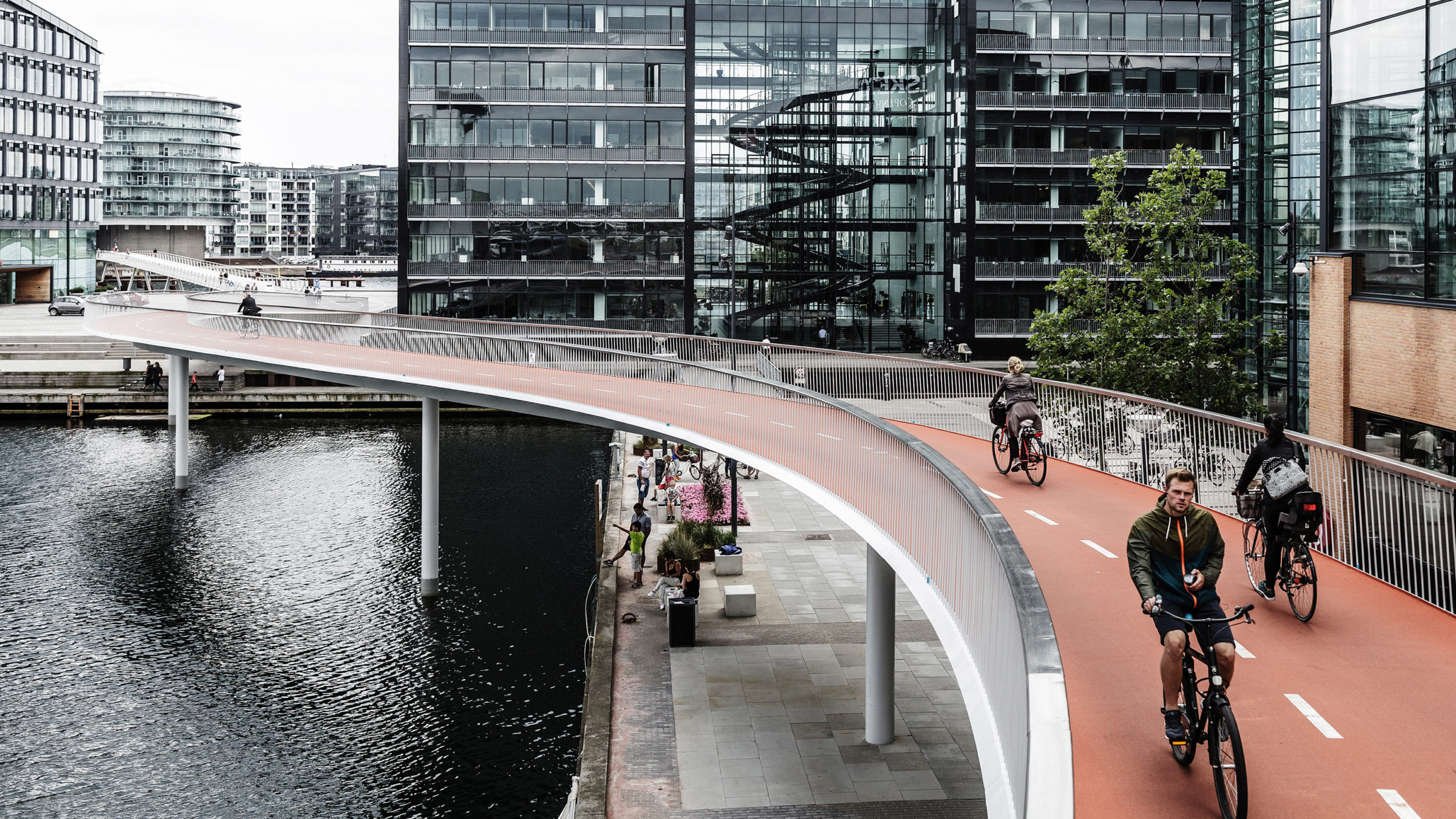
Copenhagen’s Cykelslangen gives cycling its own elevated connection between Dybbølsbro and Bryggebroen. Dissing+Weitling describes a 230-metre bridge that separates riders from the pedestrians below. Its sweeping line is the visible result of joining two places at different levels.
The interesting design move is to treat a connection as a place worth designing in its own right. A city can have attractive destinations and still make the stretch between them awkward. Here, the route itself becomes legible: follow the ribbon. That does not prove the whole cycling network works equally well; it shows why the gaps deserve as much attention as the landmarks.
Source: Dissing+Weitling: project and route ↗Privacy has dimensions.
ÖBB’s Mini Cabin gives one passenger an individual sleeping space within a shared night train. The operator lists dimensions of 190 × 63.5 × 90 cm and a separate hand-luggage locker taking a bag up to 40 × 55 × 23 cm. Reading light, a small table and personal storage put familiar bedtime routines inside a very small footprint.
Those measurements make the idea more tangible than the word “comfort”. This is a compact berth, not a room to stand in. For a traveller deciding whether it suits them, body space and luggage fit matter alongside the promise of privacy. Check the actual accommodation offered on your departure; a Nightjet service name alone does not identify the carriage or cabin.
Source: ÖBB: Mini Cabin dimensions and accommodation ↗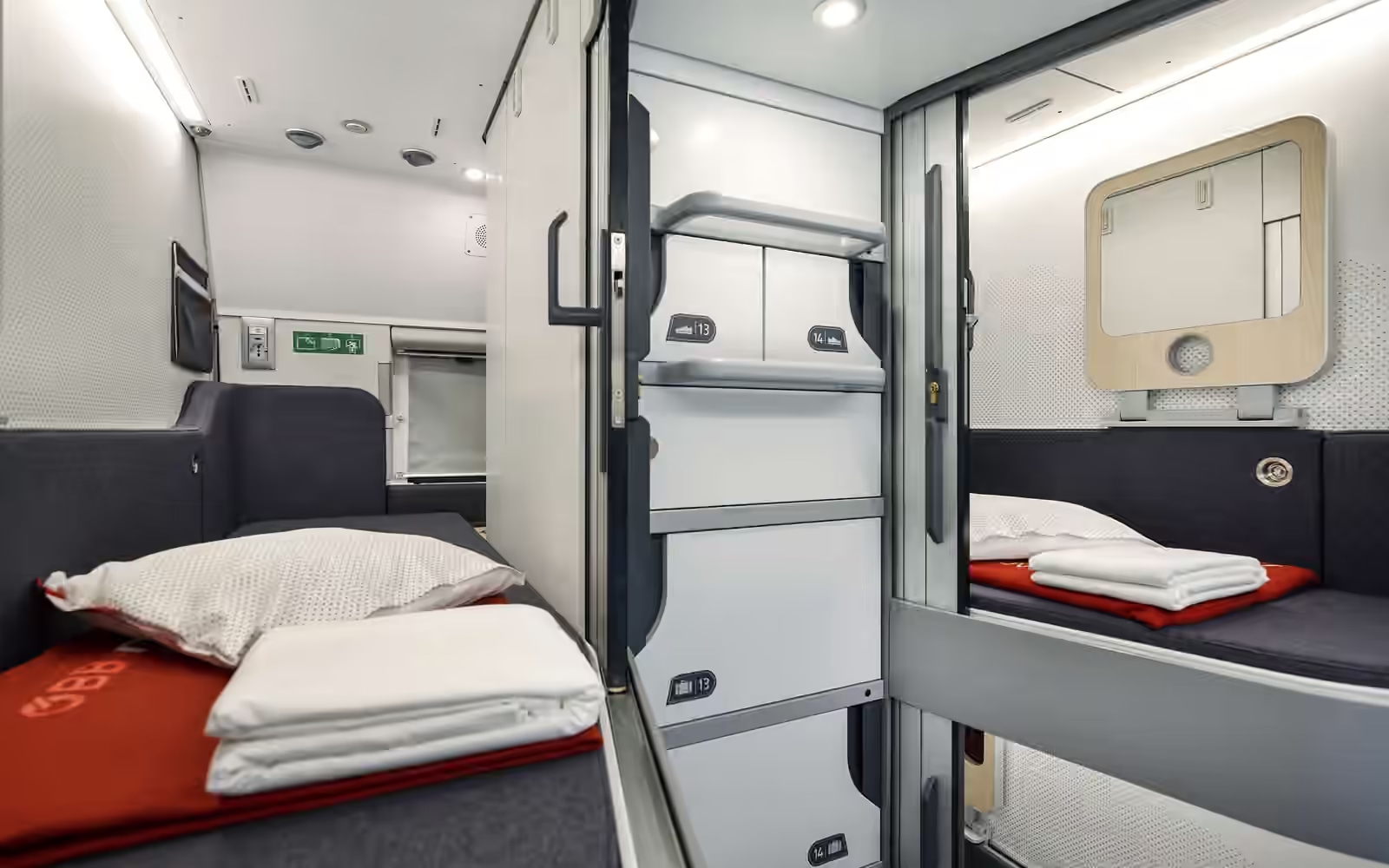
A fast boat still needs a useful service.
In its April 2025 account of the Nova hydrofoil pilot, Region Stockholm described a direct service between Tappström on Ekerö and Klara Mälarstrand. The authority reported a 25-passenger capacity and directed passengers to the regular line 89 if Nova was full or cancelled. This was a documented pilot, not a current timetable recommendation.
That operational detail changes the conversation. Lifting a hull above the water is the engineering story; having a dependable way home is the passenger story. To assess a future service, we would want to know the frequency, boarding access and fallback as well as its energy use. A compelling demonstration earns attention. A useful routine earns repeat journeys.
Source: Region Stockholm: Nova pilot, 10 April 2025 ↗
What to look for.
Look at the connection, not just the destination.
Check your space and bag before choosing your berth.
Ask about the timetable and fallback, as well as the technology.