A façade that responds without a motor.
These window shades open and close because their printed material responds to humidity.
 DE Germany
In practice. A German research demonstrator using humidity-responsive, 3D-printed shading elements, installed on a Freiburg building.
What to keep in view
The shading movement is passive; the entire building is not energy-free. Durability, response speed and performance in other climates need separate assessment.
Borrow a movement from the pine cone
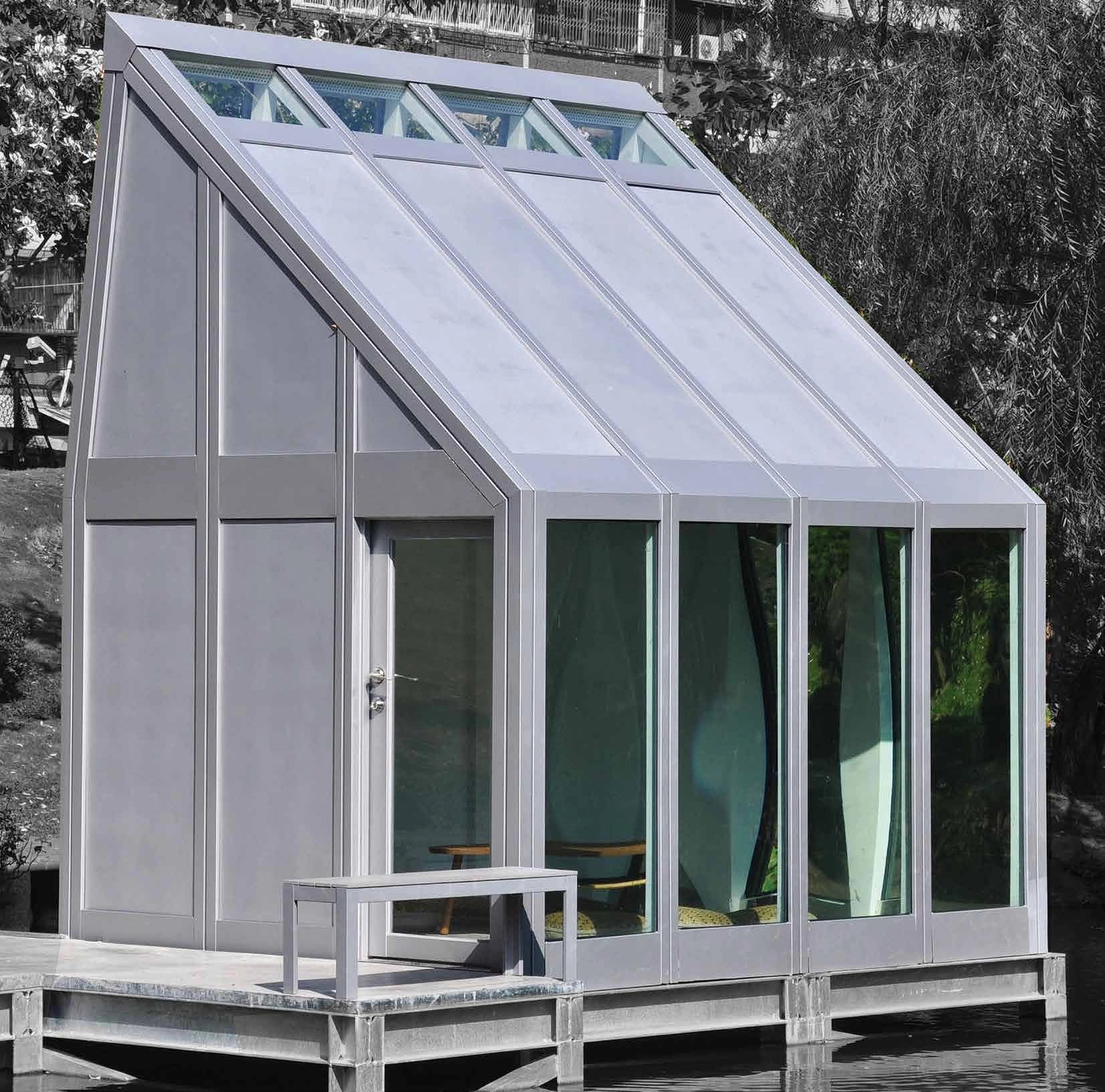
Solar Gate shades the south-facing roof glazing of the livMatS Biomimetic Shell in Freiburg. Each printed element pairs materials that respond differently to moisture, causing it to bend as humidity changes. Inspired by pine-cone scales, this movement opens or closes the shade without a motor. The installation is an architectural demonstrator developed by researchers in Stuttgart and Freiburg.
The material provides both the response to a changing environment and the movement that follows. Part of the work normally assigned to a sensor and motor is built into the shade itself.
Response can live in the material
Our reading: the important step is not just copying a pine cone’s shape. It is using the same kind of uneven swelling to perform a building task. The surrounding façade still matters: it protects the moving material while allowing the relevant conditions to reach it. A passive component works as part of a carefully designed system.
Sources (3)
- University of Stuttgart, ICD · Solar Gate 2023: project and material system
- University of Stuttgart · Bioinspired weather-responsive adaptive shading
- Cheng, Tahouni and colleagues / Nature Communications · Weather-responsive adaptive shading through biobased and bioinspired hygromorphic 4D-printing
Read next.

Let the timber find its curve.
Both use moisture-responsive material behaviour. One fixes a curved shape during manufacture; the other keeps the movement active in use.
A window can also move heat.
Both give the building envelope a more active role. Compare a passive material response with a water-based thermal circuit.