Let the timber find its curve.
The curved walls began as flat timber. For the Urbach Tower, drying was used to create a planned shape before that shape was fixed into a building component.
 DE Germany
In practice. A 14-metre tower completed in Urbach in 2019, demonstrating research-led self-shaping timber components.
What to keep in view
Controlled moisture behaviour forms the curve; lamination, machining, connections and assembly are still needed. A demonstrator is not proof that the method fits every building or timber supply.
Make the movement predictable
Wood changes dimensions as its moisture content changes. In ordinary construction, the resulting movement can be a problem. The Urbach project used a carefully arranged combination of spruce layers to turn drying into a forming step.
The University of Stuttgart’s ICD and ITKE, working with material-process researchers at ETH Zurich and Empa, developed components whose curvature could be predicted from their arrangement. The flat parts bent during controlled technical drying.
A CLOSER LOOKWatch the timber take shape
Shape first. Stabilise second.
The layers are arranged while flat. Their different responses to moisture loss are used to design the later curve.
A curve is not yet a finished component
Once curved, parts were overlapped and laminated to stabilise their geometry. Machining, connections and assembly remained necessary. The 14-metre tower completed in 2019 demonstrates the process at building scale; the building did not assemble itself.
That sequence is the important distinction. Movement is useful during manufacture, then stability is required in the completed structure. “Self-shaping” describes a particular step, not a tower intended to bend every time the weather changes.
Design the conditions as well as the shape
Our reading: the shift is from asking only what shape to make to asking what controlled material response can help make it. Drying, layer arrangement and the step that fixes the result become part of the design.
A demonstration also leaves questions for wider use: how consistently can different timber batches follow the prediction, and how will finished components be checked? The lesson is to make a material tendency repeatable and useful, while retaining the work needed to verify the result.
Built demonstrator · Completed 2019
Self-shaping timber at a 14-metre scale
The University of Stuttgart documents the completed 2019 tower, using timber components that acquire their curved form during controlled drying.
What this tells us. The full-scale structure demonstrates the fabrication method. It does not establish a general carbon saving or prove the method fits every building.
Read next.
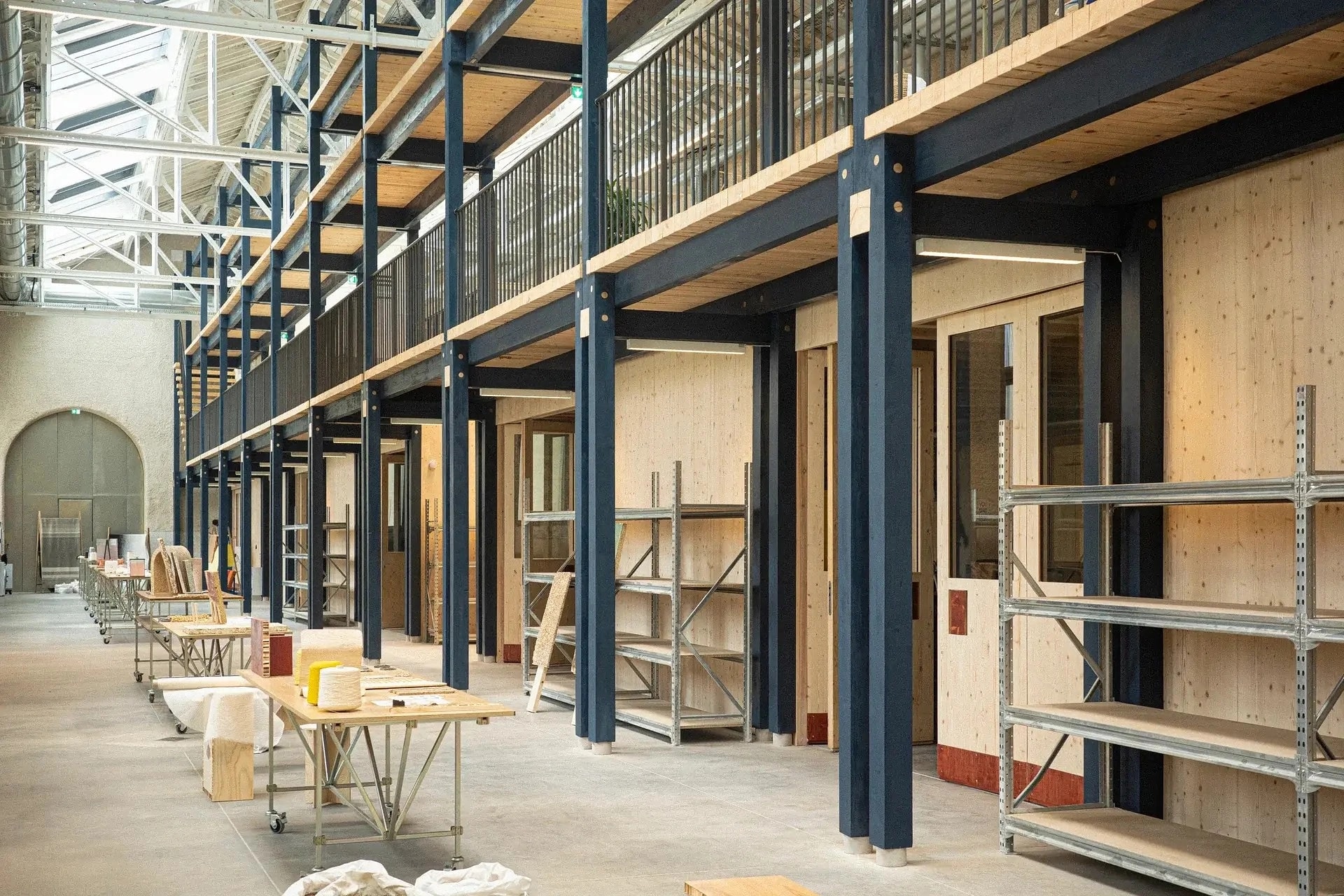
Build the materials laboratory out of its research.
Both turn construction into a visible material experiment. Regional feedstocks and moisture-shaped timber create different paths from research to a building.
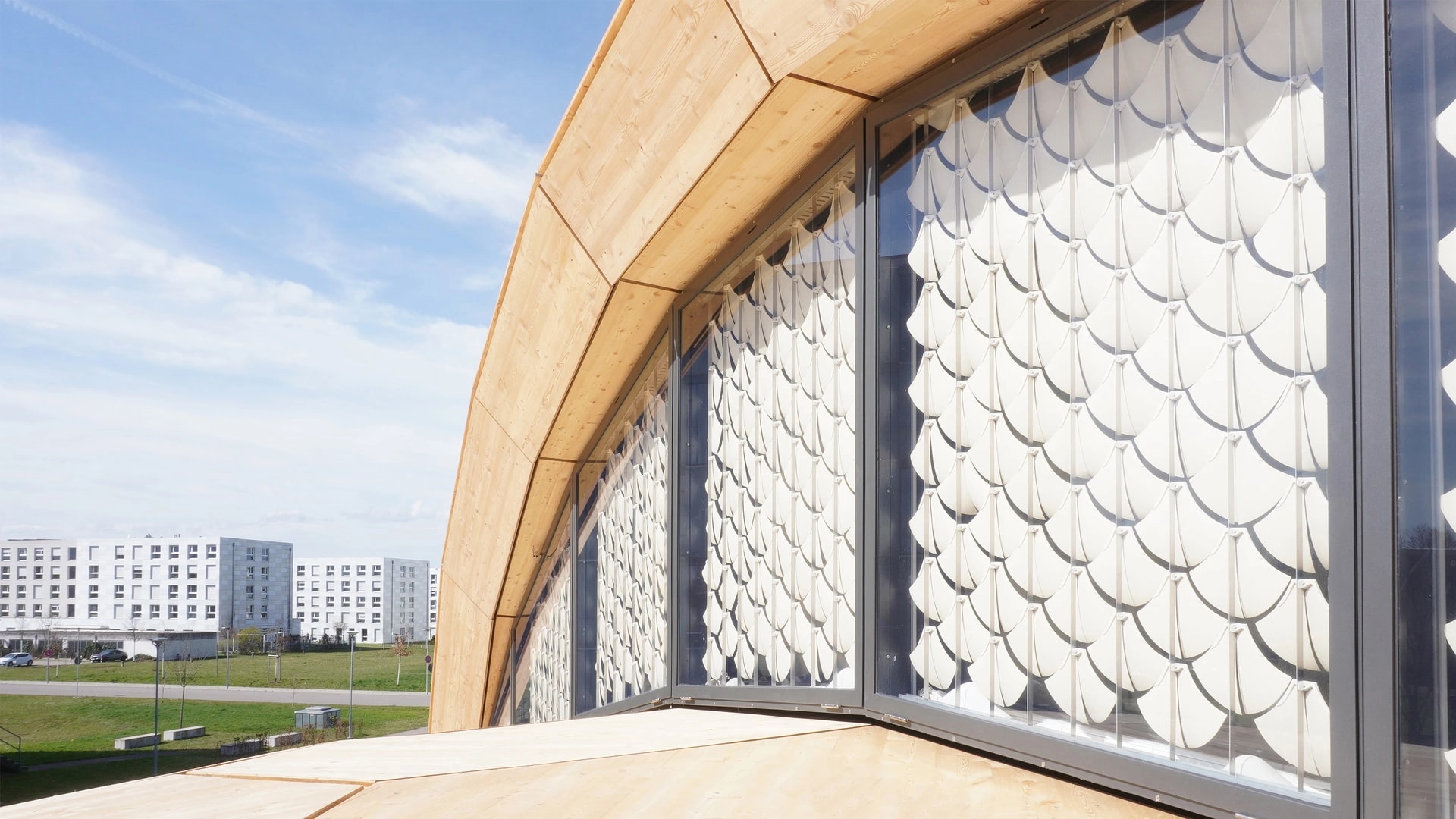
A façade that responds without a motor.
Both use moisture-responsive material behaviour. One fixes a curved shape during manufacture; the other keeps the movement active in use.